8 Elite Strategies for Recon and Route Planning for Weekend Missions

FIELD BRIEFING: FIELD BRIEFING: Recon and route planning for weekend missions is the “Intel Phase” of your operation. Beginners often make the mistake of simply following a digital GPS line without understanding the terrain, elevation gradients, or “Emergency Extraction Points.” A tactical scout knows every contour of…
FIELD BRIEFING: Recon and route planning for weekend missions is the “Intel Phase” of your operation. Beginners often make the mistake of simply following a digital GPS line without understanding the terrain, elevation gradients, or “Emergency Extraction Points.” A tactical scout knows every contour of the path before their boots ever touch the soil.
Effective recon and route planning for weekend missions ensures you aren’t caught in a box canyon during a flash flood or struggling to find level ground for a campsite as the sun sets. In 2026, the delta between a successful mission and a SAR (Search and Rescue) call is the quality of your pre-trip intelligence.
1. Topographic Intelligence: Beyond the 2D Line
A route is more than a simple linear distance; it is a complex series of vertical and horizontal changes that dictate your metabolic burn and specific gear requirements. During recon and route planning for weekend missions, you must view the map as a three-dimensional obstacle course rather than a flat path.
- The Slope Factor (Naismith’s Rule): A 5-mile hike on flat ground is a light walk; however, that same 5-mile stretch with 3,000 feet of elevation gain becomes a grueling mountain mission. Analyze the “Contour Interval” on your map; if the lines are tightly packed, you are facing a steep incline that will likely cut your travel speed by $50\%$ or more. Tactical SOP: For every $1,000$ feet of ascent, add an extra hour to your estimated time of arrival (ETA) to account for the increased physical strain and cardiovascular demand.
- Micro-Terrain Analysis: Identify potential “Terrain Traps” such as narrow gulleys, slot canyons, or heavy scree fields. These high-friction areas are high-risk zones for rockfalls, ankle injuries, or localized flash flooding. These “Danger Zones” should be navigated during peak daylight hours only, as shadows can obscure unstable footing and make vertical navigation significantly more hazardous.
2. Water Sighting and Hydration Logistics
Water is the heaviest component of your loadout (weighing approximately 2.2 lbs per liter), but it is also the most vital. When executing recon and route planning for weekend missions, you cannot afford to guess where your next resupply point is; you must have “Confirmed Intel” on every source.
- The Seasonal Variable: Identify “Water Resupply Points” on your map, but treat every blue line with skepticism. Never assume a seasonal creek—often marked by a dashed blue line—will be flowing in the late summer or during a drought.
- Verification Protocol: Cross-reference recent satellite imagery or “Social Intel” from recent trip reports to verify if high-altitude water sources are active. If the intel is unverified, always plan for a “Dry Camp” by carrying an extra 2-liter capacity from your last confirmed source, ensuring you have enough for both evening hydration and the next morning’s trek.
3. Time-to-Distance Ratios: The 2-Hour Buffer
In the backcountry, a standard pace for a fit scout is roughly 2 miles per hour. However, this metric drops significantly when factoring in a 35-lb pack, technical terrain, or the cumulative fatigue of a multi-day mission.
- The EOD Calculation: You must calculate your “End of Daylight” (EOD) precisely based on your specific coordinates and the time of year. Your recon and route planning for weekend missions must ensure that your planned campsite is reachable with a mandatory 2-hour safety buffer.
- The Risk of Night-Ops: Arriving at a site in total darkness is a “Failure Point” that increases the risk of “Site Selection Errors.” Without full visibility, you are more likely to pitch camp in a “Cold Sink,” near a “Widow-Maker” (a dead hanging branch), or on top of an active game trail, all of which compromise your safety and recovery.
4. The “Base Commander” Tool: Gaia GPS (Premium)
For modern recon and route planning for weekend missions, we recommend the Gaia GPS App. It is the industry standard for 2026, providing a multi-layered view of the AO (Area of Operations).
- Layer Overlays: Gaia allows you to overlay topographic maps with private land boundaries and historical wildfire data. This is critical for avoiding illegal trespassing or being caught in a “Burn Scar” area where falling trees are a major hazard.
- Offline Synchronization: Plan your route on a desktop at home and sync it to your phone. The “Offline Map” feature ensures you have high-resolution navigation even when you are deep in a “Zero Signal” zone.
- For More Options Be free to check out tools in our shop section.
5. Identifying Extraction and “Bail-Out” Points
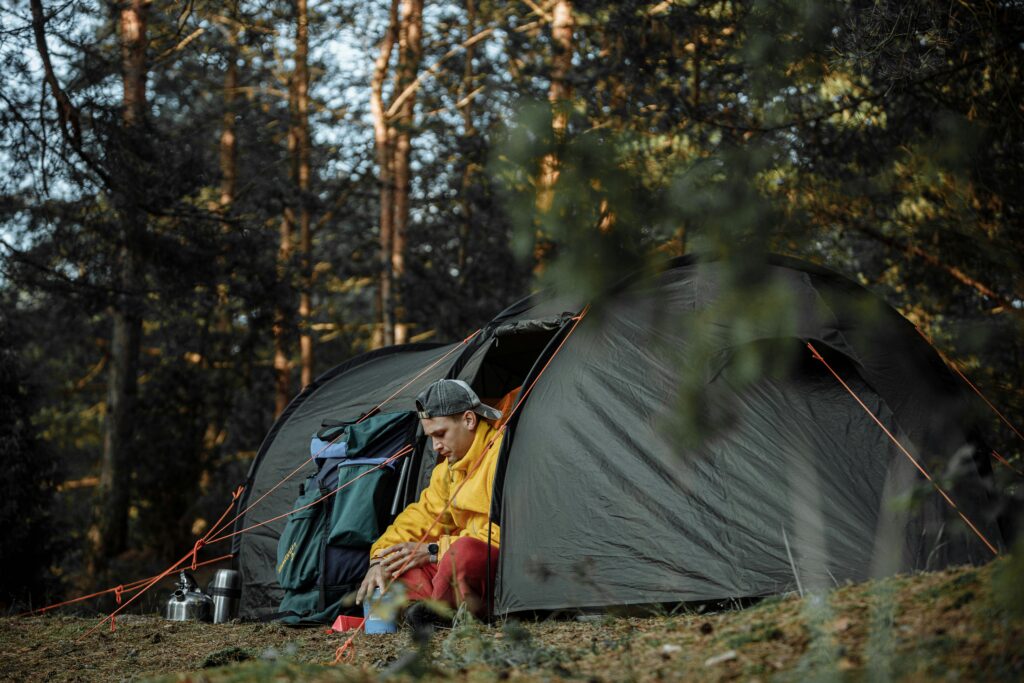
A tactical weather strategy is only as effective as your exit plan. During the intel phase of recon and route planning for weekend missions, you must identify “Bail-Out” points—mapped shortcuts, forest service roads, or secondary trail junctions that lead back to safety in the event of injury, gear failure, or a rapidly closing storm front.
- The “Point of No Return” (Pivot Point): Identify the specific coordinate where the distance to the extraction point via the remaining route is shorter than the distance back to the trailhead. Knowing this “Pivot Point” allows for decisive leadership; if a crisis occurs past this mark, you know instinctively that pushing forward is the fastest way to reach assistance.
- Emergency Egress Mapping: Mark these points clearly on your offline digital maps. In high-stress scenarios, cognitive load increases, making it difficult to find “unplanned” exits. Having pre-scouted escape routes ensures you aren’t searching for a path while the “Danger Clock” is ticking.
6. Scent and Wildlife Perimeter Planning
As part of your recon and route planning for weekend missions, you must research the local biological theater. Is the area currently experiencing high grizzly density, or are you crossing through a seasonal elk migration corridor? Identifying these high-traffic zones on your map allows you to avoid “Predatory Intersections.”
- “Triangle Outpost” Site Selection: Use the “Slope” and “Satellite” layers on your GPS app to identify flat benches or plateaus for camping before you arrive. Tactical SOP: Ensure these sites are at least 200 feet away from water sources and obvious “natural funnels” (like narrow passes). Water sources are often high-traffic wildlife corridors; by camping on a bench above the water, you maintain a tactical height advantage and keep your scent profile out of the animal’s primary path.
7. Communication Dead-Zones and Check-In SOPs
Modern scouts often rely too heavily on “Always-On” connectivity. During your recon and route planning for weekend missions, you must identify “Communication Gaps” where cell service is non-existent due to terrain shadowing or remote distance.
- The “Safety Contact” Protocol: Never depart without leaving a finalized “Mission Briefing” with a trusted home-base contact. This should include your specific trailhead coordinates, vehicle description, and a “Hard-Stop” time.
- The Hard-Stop Threshold: This is the absolute time at which your contact should initiate an emergency response. For example, if your ETA is 18:00, your Hard-Stop might be 22:00. This provides a buffer for minor delays while ensuring that if a true emergency occurs, SAR (Search and Rescue) is mobilized before the trail grows cold.
8. Calibrating for the “Human Factor”
The final stage of recon and route planning for weekend missions is the “Reality Check.” An elite plan on paper can become a disaster if it ignores the physical and psychological limits of the team.
- Squad Capabilities and the “30% Rule”: If you are scouting with beginners or an unproven team, automatically reduce your planned daily mileage and elevation gain by 30%. Fatigue is a primary cause of “Lapse in Judgment” and physical injury. A mission is only considered successful if the entire squad reaches the extraction point in good health and high morale.
- The “Slowest Link” Doctrine: Your pace is dictated by the slowest member of the team. Plan your “End of Daylight” targets based on their speed, not yours, to ensure the group stays tight and the perimeter remains secure.
Final Debrief: Knowledge is Safety
Recon and route planning for weekend missions is the mark of a professional. By analyzing topography, securing water intel, and leveraging 2026 satellite tech, you transform a risky outing into a controlled, elite operation.
Map the Grade. Verify the Water. Stay Ready.
"Observe, orient, decide, and act."