10 Pillars of Emergency Prep: First Aid and Evacuation Strategies
FIELD BRIEFING: FIELD BRIEFING: Emergency prep: first aid and evacuation strategies are the high-stakes protocols you hope to never deploy, but must know with reflexive precision. When a “Red Alert” scenario occurs—whether it is a venomous snake bite, a compound fracture, or a rapidly approaching forest fire—the…
FIELD BRIEFING: Emergency prep: first aid and evacuation strategies are the high-stakes protocols you hope to never deploy, but must know with reflexive precision. When a “Red Alert” scenario occurs—whether it is a venomous snake bite, a compound fracture, or a rapidly approaching forest fire—the luxury of “thinking it over” disappears. You must have a pre-defined “Extraction Plan” for every member of your squad before the first boot hits the trail. In 2026, the difference between a controlled rescue and a tragedy is the discipline of your emergency SOPs.
1. The “Bug-Out” Trigger: Defining Go/No-Go Criteria
Establish clear, objective “Go/No-Go” criteria during your pre-deployment briefing, long before you enter the Area of Operations (AO). In a crisis, the “Normalization of Deviance” often leads hikers to downplay risks until it is too late. If an unforecasted storm is cresting the ridge or a teammate is showing signs of moderate heat stroke—such as cognitive confusion, a “pounding” pulse, or the cessation of sweat—do not wait for the situation to become catastrophic. Initiate your emergency prep: first aid and evacuation strategies immediately while you still possess the tactical advantages of remaining daylight, residual physical strength, and independent mobility. Maintaining a wide “Margin of Safety” is the mark of a seasoned operative; retreating early is a tactical choice, not a failure.
2. Signaling for Extraction: The SOS Hierarchy
If the squad becomes immobilized by a “Tier-1” injury and cannot hike out, you must initiate a “Distress Signal.” Effective signaling relies on a tiered approach to ensure visibility across varying atmospheric conditions and is a core component of emergency prep: first aid and evacuation strategies.
- Analog Signaling & Visual Markers: Utilize a signal mirror to flash the horizon toward aircraft or ridgelines. Supplement this with the “Universal Rule of Three”—three sharp whistle blasts or three distinct signal fires arranged in a triangle. These recognized international signals alert patrols to your exact “Point of Interest.”
- Digital Signaling & Satellite Tethering: Activate the SOS button on your Satellite Messenger or PLB to trigger an uplink to a 24/7 monitoring center. Once the “Distress Packet” is sent, stay in your current location unless it is life-threatening (e.g., rising floodwaters). Moving from your “Digital Breadcrumb” can significantly delay your extraction as SAR is now tracking your fixed GPS coordinates.
3. The “Base Commander” Tool: Adventure Medical Kits (AMK) Mountain Series
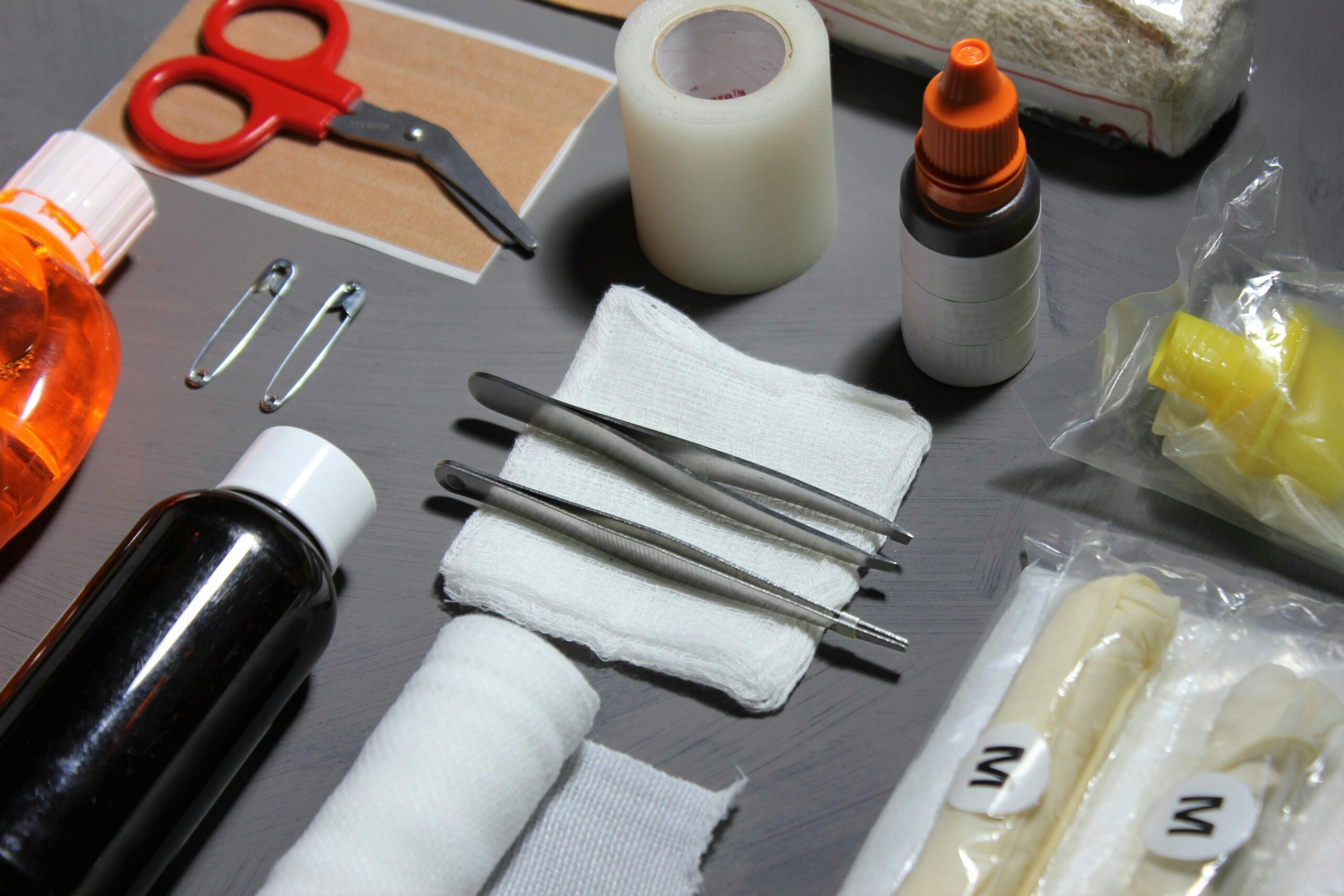
For comprehensive emergency prep: first aid and evacuation strategies, we recommend the AMK Mountain Guide Kit as your primary trauma station.
- Injury-Specific Organization: This kit is intuitively organized by injury type (e.g., “Wounds/Burn” or “Bleeding”), allowing a stressed operator to bypass the “Panic Phase” and find life-saving supplies instantly.
- Tactical Edge: It includes professional-grade stabilization tools like a SAM Splint for fractures and irrigation syringes for wound cleaning—essential hardware for stabilizing a patient during a multi-hour evacuation.
4. Hemorrhage Control: The Tourniquet Protocol
In a “Red Alert” trauma event, uncontrolled arterial bleeding is the leading cause of preventable death in the wilderness. Every member of the squad must carry an accessible CAT (Combat Application Tourniquet) in a dedicated medical pouch—never buried at the bottom of a rucksack. If a limb injury results in bright red, pulsing blood, do not waste time with gauze; apply the tourniquet “High and Tight” above the wound immediately and tighten until the bleeding stops. Use a permanent marker to write the time of application on the patient’s forehead (the “T-Time”) to provide critical Med-Evac Intel for the incoming surgical team, ensuring they know exactly how long the limb has been under occlusion.
5. Splinting and Immobilization for “Self-Extraction”
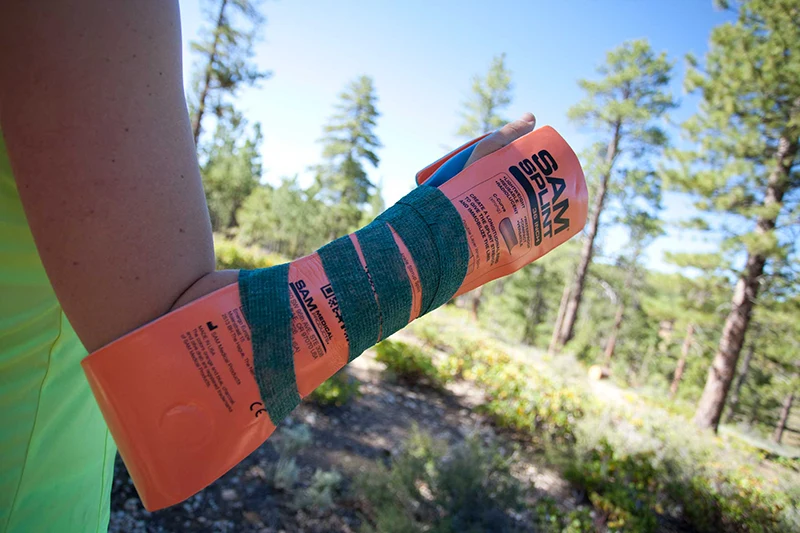
If a non-life-threatening fracture occurs but the patient retains the ability to move, you must stabilize the limb to prevent further soft-tissue damage or internal bleeding. Use a SAM Splint or improvised structural materials—such as sturdy branches, trekking poles, or internal rucksack stays—to immobilize the joints both above and below the injury site. This “Mechanical Stabilization” is the only viable way to attempt a slow, assisted “Self-Extraction” toward a trailhead or a clearer “Landing Zone” (LZ) where a helicopter or ground team can more easily reach the patient.
6. The “S.T.O.P.” Rule for Psychological Stability
When a crisis hits, the human brain’s “Freeze-Flight” response can cloud judgment and lead to secondary, fatal errors. To maintain squad discipline and avoid “Survival Panic,” adopt the S.T.O.P. acronym the moment a “Red Alert” is called:
- Sit down (physically lowering your center of gravity).
- Think clearly about the immediate threat.
- Observe your surroundings for changing weather, terrain hazards, or nearby resources.
- Plan your next move with cold logic. Taking 60 seconds to intentionally stabilize your heart rate ensures that your emergency prep: first aid and evacuation strategies are executed with clinical precision rather than reactive desperation.
7. Hypothermia Wrap: The “Burrito” Method
An injured patient who is stationary will lose core body heat rapidly through conduction and convection, even in mild weather, leading to “Environmental Shock.” A core pillar of emergency prep: first aid and evacuation strategies is the creation of a “Hypo-Wrap.” By layering a closed-cell foam sleeping pad for ground insulation and a high-loft sleeping bag encased in a waterproof bivy or tarp, you create a “Burrito” configuration. This setup traps approximately 90% of the patient’s remaining metabolic heat and protects them from wind-chill, keeping their core temperature stable until professional help arrives.
8. Navigational “Bread-Crumbs” for SAR
If you must leave an immobilized teammate to reach a point of higher elevation for better satellite reception, you must “Sanitize” the route with navigational markers. As part of your emergency prep: first aid and evacuation strategies, use high-visibility flagging tape, bright clothing, or “Cairns” (rock piles) to create a clear trail of “Bread-Crumbs” from the patient to your communication point. This ensures you can navigate back to the victim in low-light conditions and provides a high-visibility visual path for ground-based Search and Rescue (SAR) teams to follow during their final approach to your position.
9. Snake Bite SOP: Pressure and Calm
In the event of a venomous strike, disregard “Cut and Suck” myths or tourniquets, which can cause localized tissue necrosis. Your emergency prep: first aid and evacuation strategies should focus on “Pressure Immobilization.” Keep the affected limb at or slightly below heart level and keep the patient as still as possible to slow the spread of venom through the lymphatic system. Treat the patient for psychological shock and prioritize immediate digital signaling; because antivenom is time-sensitive, snake bites are always a “Tier-1” evacuation priority that requires immediate satellite SOS activation.
10. The “Last Light” Assessment
If a rescue extraction is not confirmed before nightfall, you must transition the squad from “Evacuation Mode” to “Survival Mode.” Secure a defensible perimeter before you lose visibility as part of your final emergency prep: first aid and evacuation strategies. Establish a long-burning signal fire—pre-staged with green boughs to create thick smoke on a moment’s notice—and ensure the patient is fully insulated. Your mission goal shifts from moving to “Holding the Line” and maintaining morale until the first light “Comms Window” opens and aerial reconnaissance can resume.
Final Debrief: Planning for the Impossible
Emergency prep: first aid and evacuation strategies are the final insurance policy for every mission. By carrying professional-grade AMK kits, mastering the tourniquet protocol, and maintaining “Go/No-Go” discipline, you ensure that even the worst-case scenario is met with a calculated, tactical response.
Carry the Kit. Know the Plan. Stay Ready.
"Observe, orient, decide, and act."