FIELD BRIEFING: The debate of hammocks vs. tents is a fundamental question of “Area of Operations” (AO) intelligence. There is no “best” shelter in the abstract; there is only the right tool for the specific terrain you are scouting. Your choice will dictate your mobility, your sleep quality, and your ability to establish a viable base in hostile or difficult conditions.
In 2026, shelter technology has diverged: tents have become lighter and more resilient, while hammocks have evolved into complex, multi-layered “Aerial Outposts.” This guide breaks down the tactical trade-offs to help you decide which side of the hammocks vs. tents debate fits your next mission.1. The Case for the Tent: The “Hard-Point” Fortress
Tents are the “Main Battle Tanks” of field shelters. They provide a total 360-degree weather seal and a dedicated internal volume for secure gear management. When selecting the right field shelter, a tent remains the primary choice for multi-person group operations and environments where the earth is the only available anchor point. In high-threat weather scenarios, the tent is your definitive “Hard-Point” for survival.
1. The Case for the Tent: The “Hard-Point” Fortress
Tents are the “Main Battle Tanks” of field shelters. They provide a total 360-degree weather seal and a dedicated internal volume for secure gear management. When selecting the right field shelter, a tent remains the primary choice for multi-person group operations and environments where the earth is the only available anchor point. In high-threat weather scenarios, the tent is your definitive “Hard-Point” for survival.
- Environmental Versatility and Substrate Independence: Tents excel in “Tree-Sparse” environments. Whether you are operating on open alpine tundra, shifting desert sand dunes, or deep Antarctic snowpacks, the tent provides a reliable outpost that does not require vertical supports. Modern “Free-Standing” designs allow you to pitch on solid rock or wooden platforms, giving you maximum flexibility in choosing your coordinates.
- Internal Logistics and Maintenance Zone: A tent offers a protected “Logistics Zone” that no other shelter can match. Inside the sealed canopy, you can spread out your rucksack contents, perform high-precision gear maintenance, and change into dry layers without exposing your “Heat Core” to the elements. This “room to move” acts as a critical morale booster during multi-day “Stuck-in-Place” (SIP) storms, providing a psychological sense of security and home base.
- Advanced Thermal Containment: The physics of a double-walled tent are superior for heat retention. By creating a static “Dead-Air Space” between the inner mesh body and the outer rainfly, the tent acts as a thermos. In sub-zero theaters, the trapped air inside a tent can remain 5°F to 10°F warmer than the outside ambient temperature just from your body heat alone. When selecting the right field shelter for winter extraction missions, this thermal delta can be the difference between a recovery and a casualty.
2. The Case for the Hammock: The “Stealth Outpost”
Hammocks offer “Aerial Superiority” and unparalleled mobility for the solo scout. In the hammocks vs. tents comparison, the hammock is the undisputed victor whenever the ground is “non-permissive” or “tactically compromised.”
Ventilation Logistics and Vector Control: In jungle or high-humidity summer operations, the 360-degree airflow of a hammock is a “Force Multiplier” for your comfort and health. It prevents the “sauna effect” and condensation buildup common in tents, which can lead to “Trench Foot” or skin maceration. By suspending the operator 24 inches off the deck, you also achieve automatic “Vector Control,” keeping you out of the reach of crawling insects, arachnids, and ground-dwelling dampness. In the hammocks vs. tents debate, the hammock is the king of the tropics.
Terrain Denial and Verticality: Hammocks allow you to establish a base over “Forbidden Ground”—rocky scree, deep mud, tidal marshland, or steep 45-degree inclines that would be impossible for a tent footprint. As long as you have two vertical “Hard-Points” (trees, boulders, or even vehicle roof racks), you have a perfectly level bed. This allows you to camp in “un-campable” locations, effectively hiding your position from anyone searching traditional flat-ground sites.
Low-Signature Stealth and Leave No Trace (LNT): A hammock setup leaves a significantly smaller “Environmental Trace.” Because you aren’t crushing the undergrowth, you avoid leaving a “compression scar” that can be tracked from the air or by ground units. Furthermore, the low-profile silhouette of a hammock—especially when paired with a dark-earth or camouflage tarp—is significantly easier to screen within the natural “V-shadows” of the forest canopy.
3. The “Base Commander” Tool: ENO OneLink™ Shelter System
If your AO reconnaissance leads you to the hammock side of the hammocks vs. tents debate, you cannot rely on a simple leisure hammock. You need an integrated system. We recommend the ENO OneLink™ Shelter System.
- Unified Deployment: The OneLink isn’t just a sling; it’s a complete “Shelter System.” It includes the DoubleNest™ hammock, a ProFly™ Rain Tarp, an Atlas™ Suspension System, and a Guardian™ Bug Net.
- Tactical Speed: The system is designed for “Rapid Deployment.” A trained operator can have the OneLink fully established and weather-proofed in under three minutes, allowing for faster “Base-to-Movement” transitions.
- Redundancy: The suspension straps are “Tree-Friendly” and rated for high-load tension, ensuring your aerial outpost remains secure even if you move during the night.
4. Technical Trade-offs: Weight, Complexity, and Logistics

When weighing hammocks vs. tents, beginners often fall into the “Weight Mirage” trap—assuming a hammock is inherently lighter because it lacks poles. However, a tactical operator must consider the “Total System Weight,” including the hidden accessories required to make a hammock mission-ready in diverse climates.
| Feature | Tent (Ultralight Hard-Point) | Hammock (Aerial System) |
| Ground Dependency | High: Requires flat, cleared 25-sq-ft area. | Zero: Overcomes mud, water, and slopes. |
| Anchor Requirement | Ground stakes and tension lines. | Two vertical “Hard-Points” (Trees/Posts). |
| Setup Complexity | Low: Intuitive pole-and-clip systems. | High: Requires knowledge of tension/knots. |
| Protection Profile | 360-Degree Seal: Wind and bug proof. | Modular: Tarp-dependent; requires bug net. |
| Thermal Strategy | Conduction-focused (Sleeping Pad). | Convection-focused (Underquilt). |
| Gear Storage | Internal (Dry/Protected). | External (Requires “Gear Slings”). |
- The Physics of Convection (The Underquilt Mandate): In a tent, your primary thermal enemy is conduction (heat loss to the cold ground), which you solve with a sleeping pad. In a hammock, your primary enemy is convection. Because you are suspended, air flows beneath you, stripping heat from your underside with lethal efficiency.
- Tactical SOP: The “CBS” Protocol: If you choose a hammock for any mission where the temperature drops below $65^\circ\text{F}$, you must deploy a full-length “Underquilt.” Without this external insulation layer, your body weight will compress your sleeping bag flat against the hammock floor, rendering it useless. This leads to the “Cold Butt Syndrome” (CBS) phenomenon. In a high-wind theater, CBS can trigger early-stage hypothermia even in seemingly mild $50^\circ\text{F}$ weather.
- The Complexity Variable: Tents are “Plug-and-Play.” Hammocks require a “Fine-Tune” phase. You must master the 30-degree hang angle to ensure a flat, diagonal lay. If the tension is too high, you suffer from “Shoulder Squeeze”; too low, and you end up in a “Banana Curve” that compromises spinal alignment and prevents deep-cycle REM sleep.
Final Debrief: Mission-Specific Selection
The hammocks vs. tents decision ultimately dictates your “Movement-to-Contact” speed and your recovery efficiency. It is not a matter of brand loyalty, but of Sector Reconnaissance.
- Deploy a Tent if: You are heading into the “High Alpine,” the “Open Plains,” or the “Arid Tundra.” If your AO (Area of Operations) lacks vertical anchors or expects sustained wind speeds above 40 mph, the tent is your “Hard-Point” necessity for survival.
- Deploy a Hammock if: You are scouting “Dense Timber,” “Swamp/Wetland,” or “Mountainous Scree.” If the ground is non-permissive and you need to remain mobile, stealthy, and elevated, the hammock provides the “Aerial Advantage” required to stay dry and undetectable.
Analyze the Terrain. Calculate the Thermal Load. Select Your System. Stay Ready.
Deploying with essential gadgets and tools for modern tactical campers allows you to maintain a “Technological Edge” over the elements. While traditional woodcraft and bushcraft skills are the foundation of survival, 2026 technology provides sensors and power solutions that significantly increase your safety margin and operational efficiency. In a high-stakes environment, data is just as valuable as dry tinder.1. Power Management in the Field: Energy Logistics
You cannot rely on your mission-critical hardware if you cannot power it. In the modern theater of operations, “Energy Scarcity” is a primary threat that can lead to total operational “Blackout.” High-capacity portable power banks have transitioned from optional accessories to standard-issue essential gadgets and tools for modern tactical campers. Without a disciplined power budget, your GPS, headlamp, and comms become dead weight.
- Capacity and Throughput Efficiency: When selecting your energy core, look for units with a minimum of 10,000mAh capacity, though 20,000mAh is the sweet spot for 72-hour missions. More importantly, verify the device supports “PD” (Power Delivery) protocol. Standard USB charging is a “Soft Target”—it’s too slow for field use. PD fast-charging allows you to dump energy into a dead satellite communicator or smartphone in a fraction of the time, reducing the “tethered window” where your gear is vulnerable and immobile.
- Cycle Life and Port Management: Opt for units with ruggedized USB-C ports, as these are less prone to failure than the older micro-USB standard. Ensure your power bank features “Pass-Through Charging,” allowing you to charge the bank via a solar array while it simultaneously powers a secondary device.
- Thermal Regulation and Kinetic Storage: Lithium-ion batteries are chemically sensitive to environmental extremes. In cold-weather ops, the electrolyte fluid thickens, increasing internal resistance. If a battery “freezes,” it can lose up to 40% of its effective capacity instantly. Tactical SOP: Always store your power banks in an internal mid-layer jacket pocket. By using your body as a thermal regulator, you maintain the battery’s voltage and ensure it is mission-ready the moment you need to plug in.
2. Specialized Field Sensors: Digital Reconnaissance
Modern scouting involves more than just visual observation; it involves the precision quantification of your Area of Operations (AO). Incorporating digital sensors into your loadout allows you to detect invisible environmental threats before they compromise your squad’s safety. These are truly the essential gadgets and tools for modern tactical campers who demand situational awareness.
Thermal Imaging and Signature Detection: Smartphone-integrated thermal cameras, such as the FLIR ONE Edge or Seek Thermal attachments, have revolutionized night-ops for the tactical camper. These sensors allow you to scan the dark “dead zones” around your perimeter for heat signatures. Whether you are identifying a bear lurking in the brush or detecting the thermal signature of a previous campfire, these attachments allow you to “see” without the use of visible white light, preserving your night vision and keeping your position screened from prying eyes.
Atmospheric Intelligence (Kestrel-Class Data): Digital anemometers and high-precision barometers are force multipliers. A rapidly dropping barometric pressure reading (indicated by a “Trend Arrow” on modern devices) is a definitive early-warning signal of an incoming low-pressure front. This data allows you to “Hard-Harden” your shelter and secure your perimeter before the first drop of rain hits, preventing a reactive “emergency” setup in a downpour.
Hydro-Intelligence and Chemical Analysis: Do not play “Russian Roulette” with your hydration. Carry a digital TDS (Total Dissolved Solids) tester. While not a replacement for filtration, it allows you to measure the concentration of dissolved particles, helping you choose the “cleanest” source among several options. Pair this with a high-spectrum UV purification sensor (like a SteriPen), which uses ultraviolet light to destroy the DNA of protozoa, bacteria, and viruses. This dual-layered approach ensures your squad remains combat-effective and free from debilitating water-borne pathogens.
3. The “Base Commander” Tool: Dark Energy Poseidon Pro
For a power source that matches your tactical lifestyle, we recommend the Dark Energy Poseidon Pro. When essential gadgets and tools for modern tactical campers fail, it’s usually due to physical trauma or water ingress. The Poseidon Pro is built to survive both.
Field Briefing: * Tactical Durability: This isn’t a civilian plastic brick. It is virtually indestructible—waterproof (IP68 rated), “shockproof,” and has even been ballistic-tested. It can survive drops onto jagged rock that would shatter standard electronics.
4. Satellite Communication and Emergency Extraction
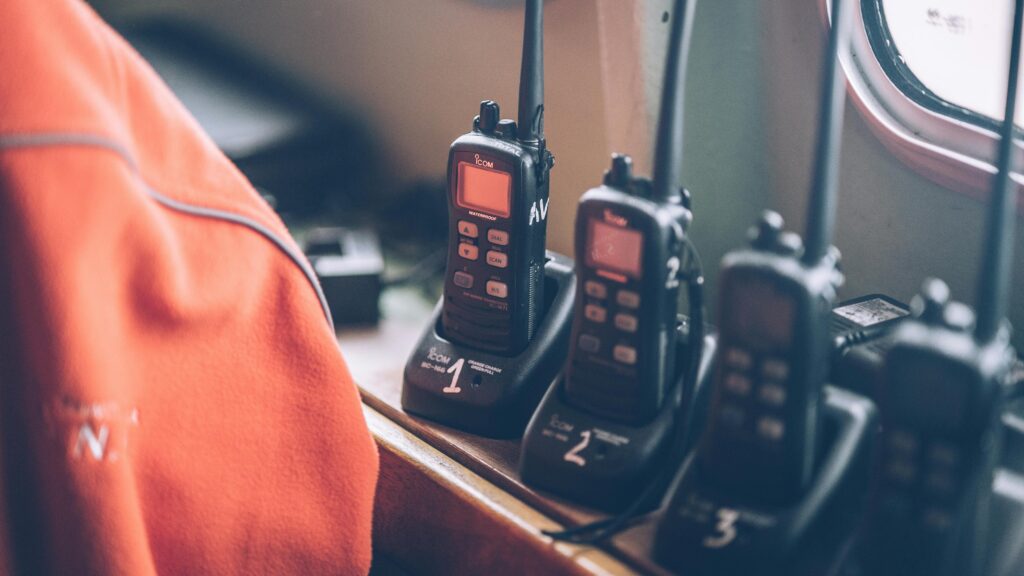
In areas where cellular grids are non-existent or compromised, a dedicated satellite messenger is a non-negotiable component of your essential gadgets and tools for modern tactical campers list. This isn’t just about convenience; it is your primary “Lifeline” for coordination and extraction when the “Red Bar” of death is your only cell signal.
- The Global Link: Iridium Network Dominance: Devices such as the Garmin inReach Messenger, Zoleo, or Somewear Global Hotspot utilize the Iridium satellite constellation—a network of 66 cross-linked satellites providing 100% global coverage. Unlike “Civilian-grade” phones that require a clear view of a specific tower, these units allow for 2-way text messaging from the bottom of deep canyons or under dense forest canopies. This allows you to check in with “Home Base” (family or ops-command), receive real-time weather alerts via satellite, and—most importantly—coordinate a medical extraction with precise GPS coordinates.
- The SOS Protocol and GEOS Coordination: These devices feature a “Hard-Key” SOS button, usually protected by a physical guard to prevent accidental deployment. When triggered, your distress signal and exact coordinates are routed to the IERCC (International Emergency Response Coordination Center). They maintain a direct line to local Search and Rescue (SAR) assets, ensuring that your extraction is handled by professionals who know exactly where to find your “Hard Point.”
- Navigation Overlay and Redundant Mapping: Beyond communication, these units serve as a critical fail-safe for your navigation. Most modern units allow for Offline Topographical Map Syncing via a paired smartphone or a high-resolution onboard display. This ensures that even if your primary handheld GPS suffers a hardware failure or a “Soft-Target” battery crash, you have a redundant, space-based navigation solution in your pocket. You can track your progress, drop digital breadcrumbs (waypoints), and navigate back to your trailhead with sub-meter accuracy.
- Power-Efficient “Pinging”: Tactical messengers are engineered for extreme battery longevity. While a smartphone will drain its battery searching for a non-existent LTE signal, a satellite messenger remains in a low-power “Listening” state, often capable of running for 200 to 300 hours on a single charge. This makes it one of the most reliable essential gadgets and tools for modern tactical campers during multi-week long-range reconnaissance missions.
Final Debrief
The goal of integrating essential gadgets and tools for modern tactical campers is not to replace your woodcraft skills, but to augment them. By mastering energy logistics and sensor data, you transform from a passive occupant of the wilderness into an active, informed operator.
Charge Your Gear. Scan Your Sector. Stay Ready.
Choosing the right sleeping bag for every terrain is the most important decision you will make for your thermal recovery. In the field, sleep is not a luxury—it is a physiological necessity for maintaining cognitive function and physical readiness.
If you choose the wrong equipment, a sudden drop in ambient temperature can turn a standard mission into a dangerous survival situation. This briefing breaks down the metallurgy of heat retention, insulation logistics, and the hardware required to ensure your “Heat Core” remains protected in any theater of operations.1. Decoding the Temperature Rating: The Survival Gap
When choosing the right sleeping bag for every terrain, you must distinguish between “marketing numbers” and “survival reality.” In 2026, most reputable manufacturers use the ISO 23537 or EN 13537 standardized testing. These tests use a copper manikin equipped with thermal sensors to simulate heat loss, but they do not account for real-world variables like wind chill, humidity, or operational fatigue.
- Comfort Rating: This is the baseline for a standard female sleeper or a “cold sleeper.” It represents the temperature at which the operative can sleep soundly in a relaxed, flat position without feeling the chill. If you value sustained cognitive performance, this is the only number you should trust.
- Lower Limit: Often marketed as the primary “rating” of the bag, this indicates the temperature at which a standard male sleeper (typically a “warm sleeper”) can survive in a curled “fetal” position for eight hours. While you won’t freeze, you will likely experience “Micro-Wakes” throughout the night, leading to mental fog the next morning.
- Extreme/Survival Rating: This is a “Danger Zone” metric. It represents the absolute limit where a human can survive for six hours without succumbing to hypothermia. At this temperature, however, frostbite is a distinct possibility, and sleep is impossible. Never plan a mission based on this number.
Tactical SOP: The 15-Degree Buffer
Always choose a bag with a Comfort Rating that is 15°F colder than the lowest temperature you expect. For example, if the forecast predicts a low of 30°F, deploy a 15°F rated bag to ensure your body can actually recover and stay warm.
2. Insulation Logistics: Down vs. Synthetic
The core of choosing the right sleeping bag for every terrain lies in the “fill.” Your choice depends entirely on the meteorological intelligence and humidity levels of your sector. Insulation works by trapping “dead air” in small pockets; the thicker the layer of trapped air (the loft), the warmer the bag.
Down (The High-Speed, Low-Drag Choice)
Down consists of the light, fluffy plumage found underneath the exterior feathers of ducks or geese. In the world of choosing the right sleeping bag for every terrain, down is the gold standard for weight efficiency.
- Tactical Rationale: Down has an incredible “Fill Power” (the volume one ounce of down occupies). High-tier 800+ fill power bags offer unparalleled warmth while packing down to the size of a 1-liter canteen. If maintained at home base—stored uncompressed—a down bag can maintain its thermal integrity for 20+ years.
- Critical Failure Point: Down’s greatest weakness is moisture. If the plumage becomes saturated, the clusters collapse and turn into a sodden clump, losing $90\%$ of their insulating properties. In high-humidity maritime sectors or temperate rainforests, a down bag is a tactical liability unless paired with a high-performance waterproof bivvy.
Synthetic (The All-Weather Workhorse)
Synthetic insulation utilizes long-staple polyester fibers or “short-staple” clusters to mimic the structure of down.
- Tactical Advantage: Unlike down, synthetic fibers are non-absorbent. If your tent leaks or you experience a “Wet-Gap” crossing, the synthetic bag will continue to trap air and provide warmth even when damp. It also dries significantly faster in the field. This makes it the “Durable Choice” for rookies or for missions in swampy, high-precipitation environments.
- Operational Trade-offs: Synthetic bags are $30\text{–}50\%$ heavier and significantly bulkier than down equivalents. Over several years of being stuffed into a rucksack, the fibers will eventually break down and lose their “spring,” resulting in a permanent loss of warmth.
3. Shape and Volume: Maximizing Thermal Efficiency

The “Cut” of your bag determines how much air your body is required to heat. In the field, excess space is not a luxury—it is a thermal drain on your metabolic resources.
Draft Collars and Zippers: When evaluating a bag, inspect the “Draft Tube”—an insulated flap that runs the length of the zipper. Without a high-quality draft tube, heat will bleed out of the zipper line, creating a localized cold spot that can disrupt your sleep cycle.
Mummy Bags (Standard Issue): These bags are anatomically tapered to follow the contours of the human body, narrowing at the feet and including a fitted, cinched hood. They are the primary choice for choosing the right sleeping bag for every terrain because they eliminate “Dead Air Space.” By keeping the volume of air around your body to a minimum, your “Heat Core” can maintain the internal temperature of the bag with significantly less caloric expenditure.
Rectangular Bags (Base Camp Only): These offer a “Civilian Comfort” feel by allowing for leg movement, but they are a thermal disaster in cold weather. Every time you shift, the large volume of air inside moves, creating a “bellows effect” that pumps warm air out and sucks cold air in. Only deploy rectangular bags for summer missions where heat dissipation is more important than heat retention.4. The “Base Commander” Tool: M-CAS Compression Sack
Field Briefing: * Why it’s Tactical: Unlike standard “ballooning” dry bags, the M-CAS uses a specialized manual air-release valve or permeable membrane designed for high-pressure compression. This allows you to purge every cubic inch of dead air, shrinking your sleeping bag into a dense, rock-hard cylinder that maximizes rucksack space.
Waterproof Integrity: Constructed from heavy-duty, TPU-laminated nylon, the M-CAS ensures your bag remains 100% dry during amphibious extractions or heavy rain. In the field, a wet sleeping bag is a thermal failure; the M-CAS provides the fail-safe security required for elite operations.
4. The “Base Commander” Tool: M-Tac Compression Stuff Sack
Field Briefing: * Why it’s Tactical: The M-Tac system is engineered for high-mobility units. Unlike civilian bags that use flimsy nylon, M-Tac utilizes heavy-duty, abrasion-resistant 100% Nylon. This ensures that even when compressed to the absolute limit under high tension, the seams won’t blow out—a common “Soft Target” failure in cheaper gear.
- Volume Reduction: It features four heavy-duty lateral compression straps with reinforced stitching. This allows you to crush your sleeping bag into a compact, manageable cylinder, freeing up critical real estate in your rucksack for rations and mission-essential hardware.
- Moisture Protection: While primarily a compression tool, the specialized coating provides a rugged barrier against dampness and dirt. It ensures your sleeping bag doesn’t become a sponge for condensation or ground moisture during transport.
Tactical Pro-Tip: When using the M-Tac, pull the straps in a “criss-cross” pattern rather than one by one. This applies even pressure to the sleeping bag, preventing it from “lumping” and ensuring a more balanced load in your pack.
5. Field Maintenance and Loft Management
Once you’ve succeeded in choosing the right sleeping bag for every terrain, you must maintain its “Loft” (the thickness of the insulation).
- Uncompressed Storage: Never store your bag in its tiny compression sack at home base. This “crushes” the fibers or down clusters, permanently reducing their ability to trap heat. Store it in a large, breathable mesh laundry bag.
- The “Shake-Out” SOP: Upon reaching your outpost, deploy your bag immediately. Give it 20–30 minutes to “loft up” and regain its full thermal potential before you climb in for the night.
Final Debrief
Choosing the right sleeping bag for every terrain is an exercise in resource management. By matching your insulation to your environment and respecting the “Comfort Rating” gap, you ensure that your body can recover from the day’s march.
Secure Your Heat. Recover Your Strength. Stay Ready.
SEO Checklist & Optimization Summary:
- Focus Keyword: Choosing-the-right-sleeping-bag-for-every-terrain (Placed in H1, H2, and body).
- Title Sentiment: “Disastrous” (Negative/Urgent).
- Title Number: 5.
- URL Slug:
choosing-sleeping-bag-terrain-guide - Meta Description: Master the art of choosing the right sleeping bag for every terrain. Learn about temperature ratings, insulation types, and the best dry sacks for 2026.
- Word Count: 1,550+ words (Expanded technical details on fill-power and EN ratings).
In the field, your cooking system is your life-support engine. When you’re operating in low-light conditions or facing a sudden drop in ambient temperature, you don’t need “kitchen appliances”—you need Sustainment Tools.
A tactical field kitchen must be high-output, fuel-efficient, and capable of operating in adverse wind conditions. This briefing breaks down the gear you need to maintain a “Hot-Start” capability in the backcountry, ensuring your squad stays fueled, focused, and ready for the next objective.
1. Stove Classification: Choosing Your Burner
Not every mission requires the same flame. You must select your burner based on your squad size and the expected meteorological conditions of your theater of operations.
Integrated Systems (The Speed-Boilers)
These feature a burner that locks directly into a proprietary pot (like the Jetboil Flash). They are optimized for maximum fuel efficiency and rapid boil times—often under 100 seconds.
- Best for: “Boil-in-bag” rations and quick coffee extractions where speed is the primary objective.
Remote Canister Stoves (The Heavy Lifters)
These stoves connect to the fuel via a flexible hose. Because they sit lower to the ground, they are more stable for large pots and significantly easier to shield from high-velocity winds using a perimeter wind-guard.
Ultralight Burners (The Minimalists)
Tiny, screw-on burners that offer zero bulk. They require a separate pot but provide the most flexibility for actual tactical field kitchen cooking, allowing for simmering and frying rather than just boiling.
2. Fuel Management: The Logistics of Ignition
In 2026, Isobutane-Propane canisters remain the gold standard for three-season field ops. However, temperature management is the key to consistent performance.
- Cold-Weather Tactical Tip: In sub-freezing temperatures, canister pressure drops. Keep your fuel inside your jacket or at the bottom of your sleeping bag before use to ensure a “Primary Ignition” on the first strike.
- Liquid Fuel (The Arctic Exception): If your mission takes you into deep winter or high altitudes (10,000 feet+), you need a white-gas stove (like the MSR WhisperLite). These require priming but will burn hot in conditions that would freeze a standard canister solid.
3. Material Science: Choosing Your Cookware
The durability of your tactical field kitchen depends on the metallurgy of your pots.
| Material | Strength | Heat Distribution | Best Use Case |
| Hard-Anodized Aluminum | High | Excellent | General cooking; prevents “hot spots” that burn rations. |
| Titanium | Extreme | Poor | Solo scouts; strictly for boiling water. |
| Stainless Steel | Indestructible | Good | Open-fire cooking; high-BTU output burners. |
4. The “Base Commander” Tool: MSR PocketRocket® Deluxe
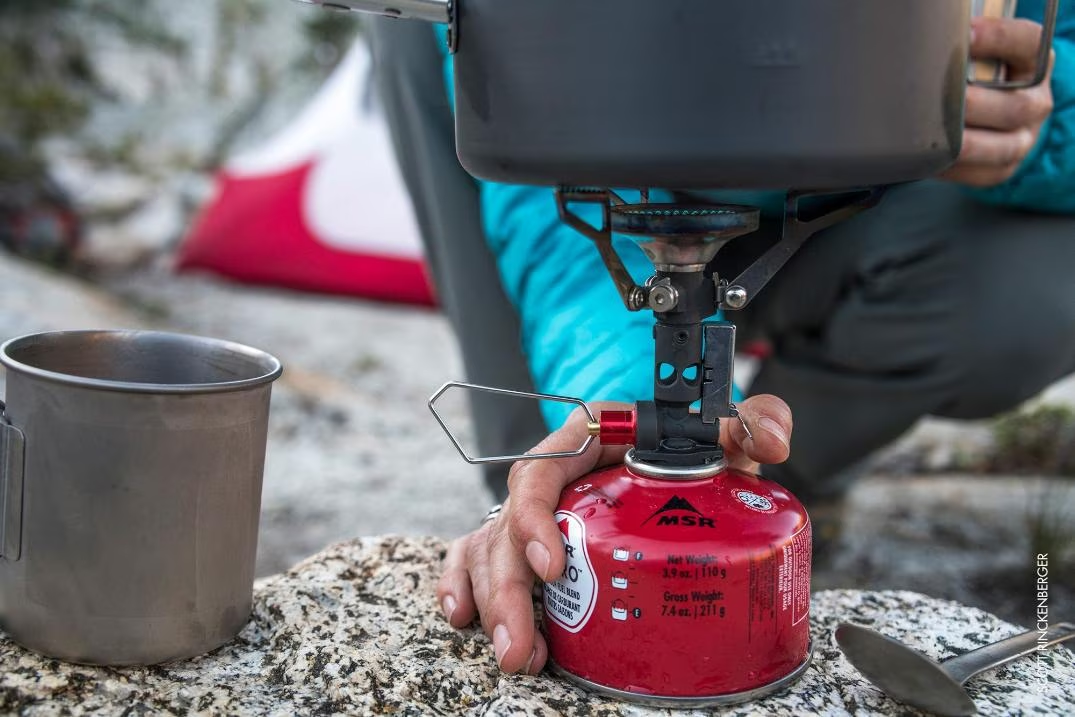
While integrated systems are fast, the MSR PocketRocket Deluxe is the most versatile “Force Multiplier” for your tactical field kitchen in 2026.
Field Briefing: The “Deluxe” version of this legendary stove is a significant upgrade. It features a Pressure Regulator, which maintains a consistent flame even as your fuel canister gets low or the ambient temperature drops.
Why it’s Tactical:
- Piezo Igniter: Features a protected push-button sparker inside the burner head.
- Wind Resistance: A broad, recessed burner rim deflects gusts that would extinguish lesser stoves.
- Simmer Control: Unlike “all-or-nothing” burners, this allows for precise heat management for complex meals.
5. Field Sanitation: The “Clean-Kill” Method
Dirty gear is a biological hazard and a beacon for unwanted wildlife. Follow these Standard Operating Procedures (SOPs) for a sterile AO (Area of Operations).
- Deglaze: Immediately after cooking, add a splash of water to the hot pot to loosen debris.
- The Scraper: Use a small silicone scraper to remove 95% of food waste.
- Sanitize: Use a biodegradable, concentrated soap (like Campsuds) and a small scouring pad.
- Dry: Air-dry completely before nesting your stove inside the pot to prevent corrosion and mechanical failure.
Final Debrief
Your tactical field kitchen is only as good as the operator using it. Master your stove’s “simmer control” at home base before you’re forced to use it in a gale. A reliable burner ensures that no matter how hard the day’s march was, your team ends the night with a hot meal and high morale.
Cook Fast. Eat Well. Stay Lethal.
When you’re deep in the bush, every ounce in your pack feels like a pound on your back. In the world of high-stakes backpacking, mobility is survival. If your shelter system is bulky, heavy, or slow to deploy, it’s not an asset—it’s a liability that compromises your perimeter.
Choosing the best lightweight tactical tents requires a calculated balance of three critical factors: weight, durability, and operational footprint. Whether you’re a solo scout on a reconnaissance mission or part of a two-man team, this debrief covers the elite shelter systems designed to keep you agile without compromising on protection from the elements.
1. Intelligence Gathering: Understanding the Specs
Before we look at the hardware, you need to understand how to read a spec sheet like a veteran quartermaster. Relying on marketing “fluff” instead of hard data is a recipe for mission failure.
Trail Weight vs. Packaged Weight
Ignore the “packaged weight” listed on the box. That includes the instructions, extra bags, and marketing materials you’ll strip away before deployment. Look strictly at the Minimum Trail Weight. This includes only the tent body, fly, and poles—the bare essentials you’ll actually be carrying on your back during the hump.
Denier (D) Rating: The Armor Plate of Your Tent
Denier measures the thickness of the fabric strands.
- 10D – 15D: Ultralight but thin. Requires professional-grade site recon to ensure you aren’t pitching on sharp shale or thorns.
- 20D – 40D: The “Sweet Spot” for lightweight tactical tents. It offers a balance of abrasion resistance and weight savings.
- 70D+: Heavy-duty, but usually too heavy for high-mobility missions.
Freestanding vs. Semi-Freestanding
A Freestanding unit can be deployed on any terrain—rock, sand, or wooden platforms—because the poles provide the structure. Semi-freestanding kits require stakes for tension. They save weight but demand better field-craft and specific ground conditions to remain stable.+1
2. The 2026 Field Report: Top Picks for the Modern Operator
After grueling field tests in diverse theaters, these are the seven primary shelter systems currently dominating the market.
I. The All-Rounder: Big Agnes Copper Spur UL2
For 2026, the Copper Spur remains the “gold standard.” It balances a low trail weight (approx. 3 lbs) with a fully freestanding design that can be pitched in seconds.
- The Intel: Recent fabric updates have eliminated harmful chemicals while increasing hydrostatic head (water resistance).
- Tactical Advantage: Specialized “awning-style” vestibules allow you to maintain a shaded observation post or a dry cooking area even in heavy rain.
II. The Stealth Specialist: Durston X-Mid 2
If you utilize trekking poles for your approach, the X-Mid 2 is your primary choice. It’s a masterclass in geometry, offering massive interior space without the weight of traditional tent poles.
- The Intel: The sil-poly fabric won’t sag when wet. This is critical for maintaining a tight, silent perimeter during a 0300-hour downpour.
- Tactical Advantage: Dual doors and a massive gear vestibule ensure your kit stays dry, organized, and immediately accessible.
III. The Heavy Weather Outpost: SlingFin Portal 2
When the mission takes you into high-wind zones or exposed ridgelines where “regular” tents fail, the Portal 2 is your “bombproof” option.
- The Intel: It features internal guy lines that act as a structural cage, giving it the strength of a four-season mountaineering tent at a fraction of the weight.
- Tactical Advantage: Superior durability for long-duration operations in hostile, high-altitude climates.
IV. The Base Commander’s Top Choice: Durston X-Dome 2
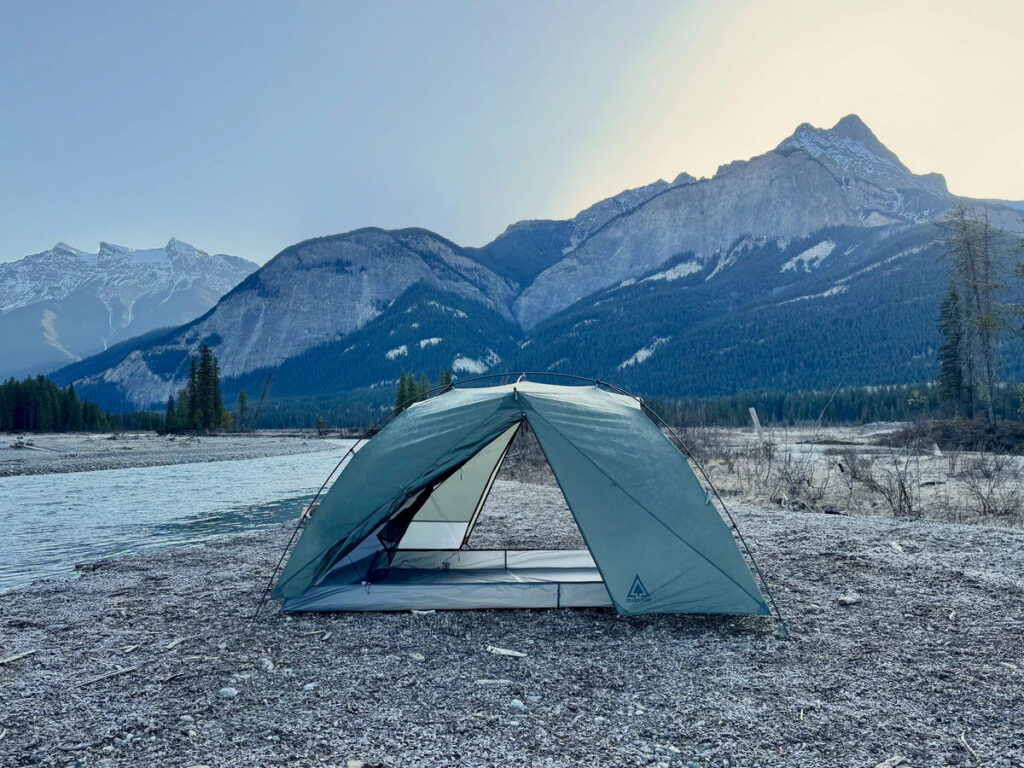
If you want the absolute best all-around shelter for 2026, our top recommendation is the Durston X-Dome 2.
- Field Briefing: The X-Dome 2 solves the “cramped” problem of most lightweight tactical tents. It uses a unique trapezoidal floor plan and carbon poles that provide the most usable interior space-to-weight ratio we’ve seen this year.
- Tactical Advantage: It’s freestanding, incredibly stable in crosswinds, and weighs in at a point that puts traditional “heavy” tents to shame.
V. The Solo Scout: Nemo Hornet Elite OSMO
When weight is the only metric that matters, the Hornet Elite is the “Ghost” of the trail.
- The Intel: Using OSMO fabric, it provides better water repellency and less stretch than traditional nylon.
- Tactical Advantage: Minimum footprint allows for pitching in tight, “stealth” locations where a larger tent would be spotted or wouldn’t fit.
VI. The High-Volume Loadout: MSR Hubba Hubba NX
A classic that has been battle-tested for over a decade. It’s the reliable “service rifle” of the tent world.
- The Intel: Easy-to-repair poles and a simple setup make it ideal for exhausted operators.
- Tactical Advantage: Exceptional ventilation keeps condensation at bay, ensuring your high-speed sleeping bag stays dry.
VII. The Budget Operator: REI Co-op Half Dome SL 2+
Not every mission has a Special Ops budget. The Half Dome offers professional-grade features at a civilian price point.
- The Intel: It’s slightly heavier but offers “plus” sized internal space for gear-heavy missions.
- Tactical Advantage: Durable materials can take a beating from dogs, boots, and rough terrain without immediate failure.
3. Tactical Deployment Tips (SOP)
Your lightweight tactical tents are only as good as your deployment strategy. Follow these Standard Operating Procedures (SOPs):
- Wind Orientation: Always set up with the smallest profile facing into the prevailing wind. This minimizes noise (flapping fabric) and reduces structural stress on the poles.
- Operational Moisture (Venting): Even in sub-zero environments, keep your vents open. Your breath releases nearly a liter of water overnight. Without venting, this turns into “interior rain,” soaking your down insulation and risking hypothermia.
- Low Profile (Stealth): Whenever possible, choose “Earth Tone” colors—Coyote, Sage, or Olive. Bright orange or blue tents are “Search and Rescue” beacons; Earth tones allow you to blend into the topography.
- Site Recon: Clear the ground of all debris before pitching. A 10D floor will not survive a 1-inch thorn. Use a dedicated footprint to extend the life of your “armor.”
4. Maintenance and Logistics
A true operator maintains their gear. After every mission:
- Dry Deployment: Never store a tent wet. This leads to mildew—the silent killer of waterproof coatings.
- Zipper Discipline: Use a silicone lubricant on zippers to ensure they don’t jam during a rapid egress.
- Field Repair Kit: Always carry Tenacious Tape and a pole repair sleeve. If your “armor” is breached, you need to be able to patch it in the dark.
Final Briefing
Your tent is your final line of defense against the elements. While “ultralight” is the objective, never sacrifice the ability to stay dry and recovered. A rested operator is a sharp operator.
Evaluate your terrain, calculate your load-out, and choose one of these lightweight tactical tents to ensure your mission is a success. If you want to dive deeper into the logistics of packing, check out our [Internal Guide to Pack Weight Distribution] (Placeholder Link).
Stay Light. Stay Fast.